How Cover Art Shapes the Sound

Art is how we decorate space, music is how we decorate time.” -Jean-Michel Basquiat

We all know the age-old adage, “don’t judge a book by its cover.” But then again, to play devil’s advocate, doesn’t the cover of a book play a major role in piquing the reader’s interest? Covers aren’t as irrelevant as your grandmother, or other parental figure, may have had you believe when they waved their finger at you and tried to convince you to read some dusty old book with a boring cover. No, let’s face it: the cover is the first thing we see, the image that sticks with us, and colors our understanding of the book. And the exact same is true of album covers! Before a listener hears a single trumpet line or piano chord, the artwork already suggests a mood, a story, or even a musical philosophy. It hints at the tone of the album and quietly prepares the listener for what they’re about to hear.

So, why don’t we dive into some of the most iconic jazz album covers and take a look at what makes them so great?

Bird and Diz – Charlie Parker & Dizzy Gillespie
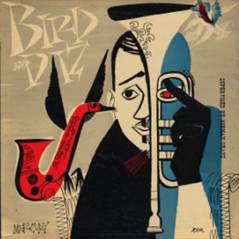
Did you know that the artist who made this cover, David Stone Martin, was one of the most prolific and iconic jazz album cover artists of the 20th century? He collaborated with countless jazz legends, such as Billie Holiday and Fred Astaire, to create over 400 covers that now evoke the mental image of mid-century jazz.

This specific album, released in 1952, captures the electric energy and exuberance between the dynamic duo of saxophonist Charlie Parker and trumpeter Dizzy Gillespie. The bold edges and selective use of color highlights the exhilarating improvisation of bebop. Martin used the crowquill ink pen to make delicate designs, such as the embellishments on the instruments. The imagery of the birds suggests to the listener that the instruments will seem to soar and fly away with the passion of the music on the ablum.

Time Out – Dave Brubeck Quartet
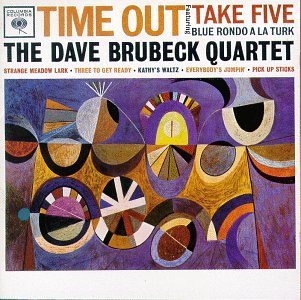
The abstract artwork on Time Out is a playful puzzle of colors and shapes, which is fitting, because the music inside the 1959 album experiments with rhythm in a similar way. The Dave Brubeck Quartet built the album around unusual time signatures like 5/4 and 9/8, which turned the rhythm into a kind of musical geometry that resembles the cover art. The bold, modernist cover hints that something innovative is happening within the grooves, and visually echoes the album’s adventurous spirit.

Bitches Brew – Miles Davis

The cover of Bitches Brew is an explosion of cosmic imagery, vibrant colors, dramatic landscapes and mysterious figures. Miles Davis’s previous album covers featured photographic portraits of the artist, so this surreal painting by Mati Klarwein was a big change. Before you even hear a single note, you already know this album will push boundaries and differ from Davis’s previous music. Bitches Brew fused jazz improvisation with electric instruments, rock energy, and studio experimentation to create a seminal landmark that influenced many musicians to come. The wild, psychedelic artwork prepares the listener for a sonic journey that is just as expansive and unpredictable.

Border Widow’s Lament – Bill Cunliffe, Martin Wind & Tim Horner
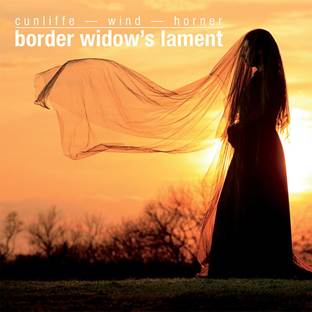
The cover of Border Widow’s Lament is a woman standing in front of what appears to be a sunrise or a sunset. She obscures the light with her dark silhouette, which, along with the melancholy title, suggests the experience of grief and pain. The border widow is a figure who has lost her beloved; whose sadness stands stark against the orange hues of the sky and the spindly tree branches in the background. Her grief is a powerful and potent force that defies the laws of nature. She exists in the liminal spaces, the borders and boundaries between night and day, life and death. Listeners will expect a deep musical experience that will allow for the catharsis of darker emotions.

My Ship – WJ3 All-Stars

The beautiful cover art for My Ship depicts a small blue sailboat amid the white of the blank canvas. In this interesting reversal, the ocean is white and the sailboat is blue, which is the opposite of what we would expect to see. And then the shore at the top is also blue brushes of paint instead of white sand. This unexpected shift sparks the listener’s imagination and makes one curious and wondrous. What other fun surprises might we expect to hear on this album?

Check out more compelling album art on Night is Alive’s albums page!

written by Jacqueline Knirnschild

photo by Pedro Netto on Unsplash

Women Who Reshaped Jazz Harmony

Photo by Vlad Shalaginov on Unsplash

Did you know that some of the most inventive harmonic thinking in jazz has come from women artists? From orchestral jazz composers to pianists expanding modal language, these artists pushed harmony forward in ways that still influence musicians today. In honor of Women’s History Month, let’s take a look at some of these impressive innovators whose work fundamentally expanded the harmonic palette of jazz!

Mary Lou Williams

Few figures in jazz history had the harmonic foresight of Mary Lou Williams. She began arranging music, and playing piano, when she was only nineteen, and quickly grew to national prominence in the 1930s with her recordings in Kansas City, Chicago and New York City. Williams wrote arrangements that expanded the harmonic vocabulary of big band jazz by weaving blues structures with more adventurous chord progressions.

By the 1940s Williams was already experimenting with the kinds of modern harmonies that would later define bebop. Her work helped to bridge between the 1920s stride piano and 1940s bebop. Musicians such as Thelonious Monk and Dizzy Gillespie visited Williams’s New York apartment for informal workshops where she shared new harmonic ideas. Her later jazz works integrated classical harmony, gospel voicings, and modal jazz, which showed how harmony could evolve while remaining rooted in tradition.

For a taste of William’s blending of jazz and advanced classical-style harmonic structures, take a listen to her 1945 composition “Zodiac Suite.”

Carla Bley

Carla Bley’s compositional voice transformed large-ensemble jazz in the late 20th century, especially in the free jazz movement of the 1960s, which took a more experimental avant-garde approach to jazz improvisation. Rather than relying on traditional functional harmony, Bley often built pieces around unexpected chord movements, tonal ambiguity, and layered harmonic textures.

Her landmark jazz opera Escalator Over the Hill blurred boundaries between jazz, rock, and avant-garde classical music. Throughout her career, she used harmony as a means of narrative storytelling. She imbued avant-garde compositions with leaner, simpler and more melodic sensibilities inspired by gospel, bluegrass and folk music. Her sparse, crystalline style eliminated unnecessary notes and sharpened the emotional impact.

Carla Bley’s 1987 piece “Lawns” showcases her ability to blend romantic, melancholic melodies with sophisticated harmony and highlights her lyrical, tender side.

Geri Allen

Geri Allen, who has a master’s degree in ethnomusicology, brought a deeply intellectual yet emotionally powerful approach to harmony. She was a member of the 1980s M-Base movement, which was a Brooklyn-based collective that emphasized complex non-Western rhythms, improvisational structures and creative collaboration. She combined the rhythmic freedom of avant-garde jazz with rich harmonic structures drawn from gospel, classical music, and modal jazz.

Rather than treating harmony as static chords, Allen viewed harmony as a fluid, evolving landscape beneath improvisation. In this way she played a major role in modernizing post-bop piano from the mid-1980s onward by introducing a more surreal approach that favored advanced modal reharmonization, layered voicings, polychords and rich atonality. She excelled in navigating atonal structures while also maintaining a deep, soulful blues connection. Allen’s harmonic language has been described as lush yet jagged, and has influenced many contemporary pianists such as Jason Moran, Vijay Iyer, and Craig Taborn.

“Feed the Fire” is the title track from Geri Allen’s 1993 album with Dave Holland and Jack Dejohnette and it captures her harmonic openness and layered piano textures.

Maria Schneider

Maria Schneider’s orchestral jazz compositions are among the most harmonically sophisticated works written for jazz orchestras today. Influenced by Gil Evans and classical impressionism, Schneider builds lush, shimmering harmonic environments that merge solo sections with ensemble textures and unfold gradually. Rather than relying on traditional 32-bar song forms and alternating solos, her compositions often unfold as long-form, linear narratives.

Her music often uses extended chords, impressionistic harmony, and orchestral color rather than traditional swing-era progressions. Schneider moved beyond the typical three-section trumpet, trombone and sax of jazz big bands and instead mixes instruments such as the flugelhorn, trombone and bass flute to create memorable timbers that mimic a French horn. The result is a cinematic harmonic language that feels closer to Debussy than to conventional big band writing.

Schneider’s piece “Hang Gliding,” released on her album Allegresse in 2000, showcases her evocative, lush style.

Expanding the Harmonic Story of Jazz

The history of jazz harmony is far richer than the standard narratives often suggest. Artists like Mary Lou Williams, Carla Bley, Geri Allen, and Maria Schneider each pushed the music in new directions, whether through bebop innovations, avant-garde composition, modal exploration, or orchestral jazz writing. And these are only a scant few that we’ve chosen to share with you today – there are countless others who have and are continuing to shape and influence the world of music every day.

These fierce women’s work reminds us that the evolution of jazz harmony has always been a collective effort. During Women’s History Month, and throughout the year, it’s worth exploring and revisiting these artists whose ideas continue to resonate in modern jazz.

written by Jacqueline Knirnschild

Jazz for Spring Cleaning

I don’t know about you, but I find spring cleaning so enjoyable and therapeutic! After the busy winter holiday season it feels so good to open the windows wide and let the fresh, crisp spring air waft through the house. Sometimes when I do my spring cleaning I even feel a bit like a Disney princess calling, singing, cajoling to all the creatures outside that are bursting with new life and energy. I feel so much lighter and freer after I’ve dusted out all the corners, cracks and crevices; and cleared away all the old bits and bobs. But you know what makes me feel even better when I’m cleaning? Yup, that’s right–some rejuvenating and energizing jazz that ushers in the reset and new season.

Jitterbug Waltz – WJ3 All-Stars

What order do you like to do your cleaning? I usually do the bathrooms first because they’re my least favorite, and then I move on to dusting and wiping down the walls, countertops and other surfaces. Last but not least I vacuum and scrub the floors. Phew! A big deep clean like that really is a full day of work! I think we’re going to need a song with some pep in its step to motivate us to get started, and “The Jitterbug Waltz” is just the one! From Night is Alive’s album Lover and Love Songs, this tune will get you shaking and a-grooving as you gather your cleaning supplies.

Don’t Know Why – Lonnie Plaxico, Douglas Plaxico & Lafayette Harris Jr.

This new jazzy rendition of the beloved Norah Jones song is a lovely tune to sing along to while you sweep and scrub. It’s supposed to be very healthy and cathartic for humans to sing, so, don’t worry about your pitch or tone and just let your voice soar! And then maybe you can dance around a bit during the groovy little instrumental interludes. Out across the endless sea, I would die in ecstasy

Are You Alright – Janis Siegel, John Di Martino & Others

Don’t you think that cleaning and singing just go together like peanut butter and jelly? I always find myself wanting to sing while I’m cleaning, so here is another song, from Night is Alive’s country jazz album Cryin’ In My Whiskey, that allows you to exercise your vocal chords while you reorganize your house. It is a bright rendition of Lucinda Williams’ 2007 tune, and invites you to think of a loved one who may be struggling. Let’s send out positive energy this spring!

Suddenly It’s Spring – John Di Martino, Harry Allen & others

Cleaning doesn’t have to be boring or toilsome. We can make it fun by pretending that the end of the mop is a microphone and the floors are your stage! Use your imagination to sing into your mic and slink around your stage as if you’re a performer at a groovy, spunky underground speakeasy. This tune, from Night is Alive’s album Call Me Irresponsible, is also perfect because it celebrates and welcomes spring! Trees stomp their feet and the birds all have coats

Here’s That Rainy Day – Lorca Hart Trio

Ah, you’ve done it. Your house is all clean, fresh and sparkly. It feels good doesn’t it? Now it’s time to light a candle, sit on your comfy couch and soak up the new spring vibes. Maybe you even want to pour yourself a glass of wine? Relax and enjoy while you listen to this peaceful number from Night is Alive’s album Colors of Jazz.

written by Jacqueline Knirnschild

Photo by Vitaly Gariev on Unsplash

Spotlight: The Women Artists of Night is Alive

For Women’s History Month this March we’d like to shine a spotlight on the many talented women artists of Night is Alive! These ladies have won countless awards, filled our records with passion and really worked hard to contribute to the jazz music community. We applaud you all for your great successes and are overjoyed to be able to celebrate your many accomplishments this month! May we raise our glasses and toast to Janis Siegel, Camille Thurman, Teddy Horangic and Andromeda Turre!

Janis Siegel

Janis Siegel’s career is just as rich and impressive as her silky smooth voice. From her dazzling vocals for The Manhattan Transfer, which received ten Grammy Awards during her tenure; to her solo career and achievements as a vocal arranger; Siegel has had her hand in many parts of the music industry. This vivid tapestry of musical expertise really shines through in her voice! Among her many accomplishments, Siegel was awarded a Grammy for her arrangement of “Birdland” in 1980, and received an honorary doctorate from the Berklee School of Music in 1993. With Night is Alive, Siegel explored a unique fusion of country-western and jazz in the album Cryin’ In My Whiskey. You can read more about her adventurous spirit in our feature interview, and don’t miss her soulful rendition of the classic song “Where Do I Put His Memory.”

Camille Thurman

A double threat on the jazz scene, Camille Thurman is equally renowned for her virtuosic tenor saxophone playing and her four-octave vocal range. Thurman is also a member of the Jazz at Lincoln Center Orchestra and as well as a composer. Her first two solo albums topped the Billboard Charts and in 2017 and 2018, and she was the runner-up in the Sarah Vaughn International Jazz Vocal Competition! Thurman has brought her luminous presence to Night is Alive through her collaboration on Lonnie Plaxico’s album Radiance, where she reimagines soul and jazz classics with effortless sophistication. We just couldn’t get enough of Thurman and ended up doing two interviews with her! The first Q&A focuses more on her formative experiences with music and the second Q&A her more recent endeavors. And don’t forget to listen to her favorite song from Radiance, “It’s a Shame.”

Teddy Horangic

Teddy Horangic brings a powerful and festive energy to the Night is Alive roster, particularly through her contributions to the holiday season. A Yale University student of Grammy-winning saxophonist Wayne Escoffery, Teddy made her professional recording debut on the label’s celebratory album This Christmas with Night is Alive. Horangic draws inspiration from legends like Sarah Vaughan and Cecile McLorin Salvant, and excels in imbuing her music with deep heartfelt emotion. For a true display of her vocal range and holiday spirit, check out her enchanting performance of “O Holy Night.”

Andromeda Turre

Andromeda Turre is a visionary artist who uses her glorious and fluid vocal tone to bridge the worlds of jazz and environmental activism. The daughter of jazz legends Steve Turre and Akua Dixon, she was raised in the heart of the New York jazz scene and has since headlined stages in 17 countries. Her latest groundbreaking project, From the Earth, is a multidisciplinary gallery exhibit that collaborated with visual artists to provide a fully immersive experience that promotes environmental justice and connects viewers with local climate initiatives. For Night is Alive, Turre shines as the vocalist for the star-studded holiday album Christmas Ain’t Like It Used To Be, where she balances classic jazz sensitivity with modern reflection. For a standout example of her storytelling prowess, listen to the titular track, “Christmas Ain’t Like It Used to Be.”

As we celebrate Women’s History Month, it’s clear that the women of Night is Alive are not just performing jazz—they are actively shaping its future. From Janis Siegel’s legendary arrangements, Camille Thurman’s dual-threat virtuosity to Andromeda Turre’s environmental activism, and the rising brilliance of Teddy Horangic, these artists represent a breathtaking spectrum of leadership, reform, and raw talent. Their contributions remind us that the heart of jazz beats strongest when it is inclusive, bold, and forward-thinking. We invite you to explore their albums, dive into their interviews, and join us in applauding these incredible women who help to make the Night is Alive community so vibrant.

written by Jacqueline Knirnschild