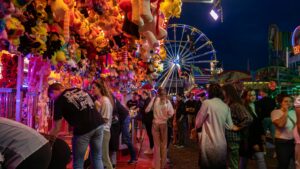

Golden hour is a term usually used in photography to describe the period of daytime shortly after sunrise or before sunset, when daylight is redder and softer than when the sun is high up in the sky. Cinematographers and photographers also sometimes call this time the magic hour because the brightness of the sky matches the streetlights, signs, car headlights and lit windows!
I don’t know about you, but for some reason the golden or magic hour just calls for some bossa nova jazz, especially right before sunset. There’s nothing like driving home after a long workday, watching the red sun soak the scenery in gold, and letting some smooth bossa nova wash over you.
Bossa nova is a relaxed style of Brazilian samba that originated in the late 1950s and early 1960s in Rio de Janeiro. Bossa nova is essentially a simplification and stylization on the guitar of the rhythm produced by a samba school band: it is calm, syncopated with chords and fingerstyles that mimic the beat of a samba groove. The complex chords in bossa nova were not derived from jazz, but the two styles evolved at the same time, and bossa nova was influenced by jazz in the harmonies used and instrumentation of songs. Nowadays, many bossa nova songs are considered jazz standards!
Now let’s listen to a few bossa nova standards to help you unwind and ease into the golden hour:
João Gilberto – Chega de Saudade
This little song made big waves in the Brazilian school of music. Released in April 1959, “Chega de Saudade” was the first composition to showcase Gilberto’s new guitar beat that gave rise to the bossa nova genre. The tune’s harmonies are also particularly sophisticated and the lyrics are elegant.
Stan Getz & João Gilberto – Desafinado
Music historians cite “Desafinado,” released in 1959, as the first official bossa nova. This song was originally composed in response to critics that claimed bossa nova was a genre for singers who can’t actually sing. In Portuguese, “desafinado” means “out of tune” which is meant to mock the criticism. English-language adaptations then emerged that reframe the title as a love song about lovers who have fallen “slightly out of tune.”
Antônio Carlos Jobim & Frank Sinatra – The Girl from Ipanema
“The Girl from Ipanema” is probably one of the most well-known bossa nova songs. With Jobim and Sinatra singing together, the song really represents the fusion of Brazilian bossa nova and American jazz. It became a worldwide hit in the mid-1960s and won a Grammy for Record of the Year in 1965.
Manhã de Carnaval – Elizeth Cardoso
“Manhã de Carnaval,” often also referred to as “Black Orpheus” appeared in the 1959 Portuguese-language film Orfeu Negro, which was a romantic tragedy based on the Greek legend of Orpheus and Eurydice but set in a contemporary favela in Rio de Janeiro during Carnaval. Versions of the song are sung or hummed by the two main characters, which makes it the main musical theme of the film. It was one of the first Bossa Nova compositions to gain popularity outside Brazil, especially in France and the U.S.
written by Jacqueline Knirnschild
Photo by Pearse O’Halloran on Unsplash